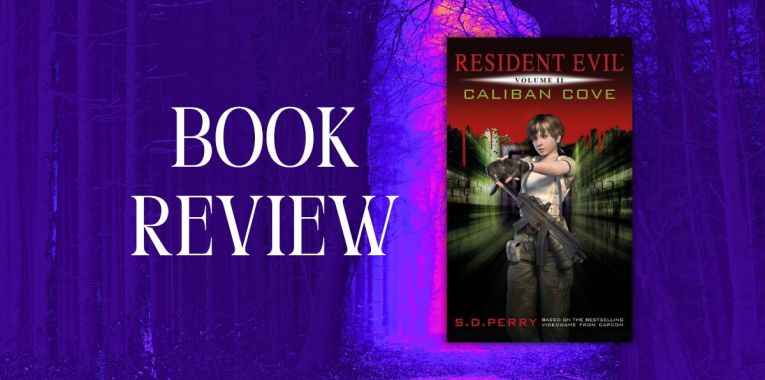
Book Review: ‘Caliban Cove (Resident Evil, #2)’ by S.D. Perry

For the final book of my 2024 reading challenge, I picked up S.D. Perry’s ‘Caliban Cove (Resident Evil, )’.

Having enjoyed Perry’s first ‘Resident Evil’ novelization, I wanted something lighthearted and easy. With its evil corporations, secret labs, and hordes of zombies, this book was a no-brainer. Pun intended.

Unlike most of Perry’s Resident Evil books, ‘Caliban Cove’ is not tied to a specific video game. There is no ‘Caliban Cove’ game – this story is Perry’s creation. Free to craft her own story, she takes us on a new romp with Rebecca Chambers, the rookie medic from the first story. The story follows the events of ‘The Umbrella Conspiracy’. Perry dives straight into the action.

Like its predecessor, ‘Caliban Cove’ is fast-paced and easy to read, making it a breeze to fly through the pages. I appreciated Perry’s creativity with new monsters and villains, bringing some freshness. That said, the ending felt rushed, and I wanted more details about some of the creatures. While keeping your big bads in the shadows can build suspense, having some payoff at the end is nice.

Although weaker than book one, ‘Caliban Cove’ is still fun – it’s good cheesy action to turn your brain off.
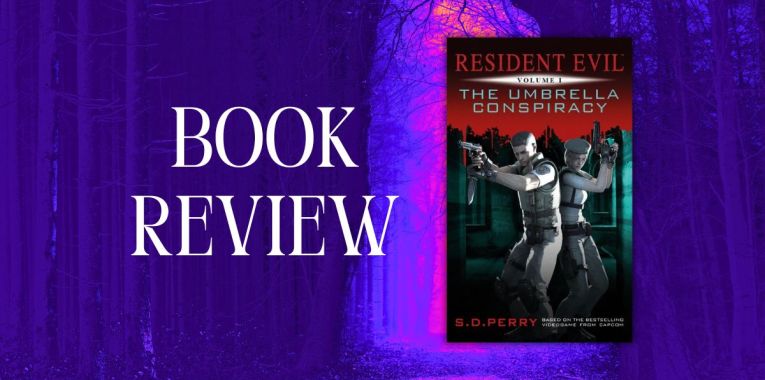
Book Review: ‘The Umbrella Conspiracy (Resident Evil, #1)’ by S.D. Perry

I picked up ‘The Umbrella Conspiracy (Resident Evil, )’ by S.D. Perry, for my next read of the year.

I’ve loved the ‘Resident Evil’ games since my older brother got ‘Resident Evil 3: Nemesis’ in the early 2000s. I’ve since devoured every game. With ‘Resident Evil 3’ day at the end of last month, I wanted to delve back into Raccoon City. But I didn’t have the time to replay the games. So I thought, ‘Why not try the novels?’ I’ve heard other fans talking about them in horror circles, and I’m a big fan of trashy books and B-movie horror.

The book follows – surprise, surprise – the S.T.A.R.S. members as they investigate trouble in Raccoon Forest. People have been disappearing, sometimes turning up eaten. Perry opens the novel with the S.T.A.R.S.’s Bravo team going missing, leaving the Alpha team to investigate. It doesn’t take long until a zombie shambles onto the page, and from there, the book follows the game’s beats. We even get P.O.V.s from Jill and Chris – the first game’s two playable characters – along with the rest of the cast.

The book follows the game’s story much more than its silver-screen counterparts. It might do too well, describing the maze-like corridors and endless puzzles. But I understand that Capcom must’ve insisted Perry do this. This adherence might also be a plus for those who felt the movies should have stuck to the source material.

I went in expecting it to be enjoyable but flawed – after all, I have a soft spot for the movies – but it turned out decent. It’s not ‘The Shining’ or anything, but who would expect that from a video game novelisation? The characters are as we remember them, with some embellishment. The settings are all there, and the atmosphere is suitable. The puzzles fit into the story, and all the monsters appear – even if killed “off-screen”.

Perry’s book scratches the itch (itchy, tasty) well if you want to return to the Spencer Mansion.

Book Review: ‘Es wächst und wächst und wächst…’ by R. L. Stine

R. L. Stine’s ‘Es wächst und wächst und wächst…’ is my penultimate read for my 2024 reading challenge.

I decided to pick up another after reading a few Goosebumps books in German to help me learn the language. I needed something easier after struggling with ‘Der kleine Prinz’ earlier in the year.

The book follows Evan, a boy whose parents left him with his old aunt as they leave town searching for a new house. Evan, who is very reluctant to do this, brings along his best pal, an old dog named Trigger. He soon meets a young girl of the same age named Andy, who shows him a dusty old toyshop with an irascible owner. The pair discover a strange tin with the word ‘Monsterblood’ (‘Monsterblut’) on the label. But, upon purchasing this treat, Evan learns it does not stop growing.

The story is classic Stine – fun, with likeable characters and easy-to-hate bullies. The book has plenty of peril, but you always know the heroes will get out of it (although, as a kid, I didn’t know this!). As my friend promised me upon gifting me ‘Der kleine Prinz’, I found the German in this book much more accessible. Some bits were tricky and required a dictionary, but I got through it. It’s getting more accessible – I’ll move on to the Fear Street novels in German soon.

‘Es wächst und wächst und wächst…’ is a great horror book for kids and is an excellent book to help adults learn a new language.

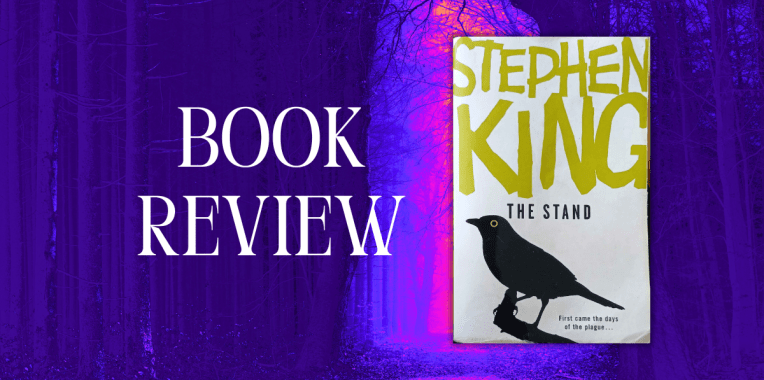
Book Review: ‘The Stand’ by Stephen King

For my latest read of 2024, I dove back into Stephen King’s ‘The Stand’.

As with most of King’s work, ‘The Stand’ is something I read as a teen and wanted to revisit. A monster of a book, I began this while on holiday in Finland over the summer. It took me from mid-July to last week to finish. When I was a kid and had no commitments, I could burn through a tome like this in a week. But those days are long gone.

You might stick with a book this long for one of two reasons: either it drags, and you dread picking it up, or you love it so much that the length doesn’t matter. ‘The Stand’ definitely falls into the latter camp. It’s an absolute triumph and one of King’s best.

The book begins with a catastrophe at a military base. What follows is a pandemic that ends almost all human life. A few smatterings of survivors remain, left to rebuild how they see fit. Groups form around two individuals who the survivors dream about. Mother Abigail, a 108-year-old black woman, serves as a force for good. Randall Flagg, an evil figure with supernatural powers, is hellbent on destruction. King writes so many characters that it’s hard to pinpoint a single protagonist. But there are clear groups of ‘heroes’ and ‘villains’, and the large cast adds depth and complexity.

The intro is electric, with that cloying, inescapable destiny thing that King does so well. As soon as the wheels start to fall off – and the body count rises – King doesn’t let up. After this, the tempo slows, and we get to know our wide cast. The characterisation of this wide range of people, from good to evil, is astonishing. As things become more complex, you can’t help but feel their losses and celebrate their wins. Nobody does this like King. You’ll be so hooked when the magical elements – e.g. prophetic dreams – come in that you won’t mind the shift to fantasy. ‘The Stand’ is a glorious book from one of the best to do it.

It’s a long read, but every single page is worth it.

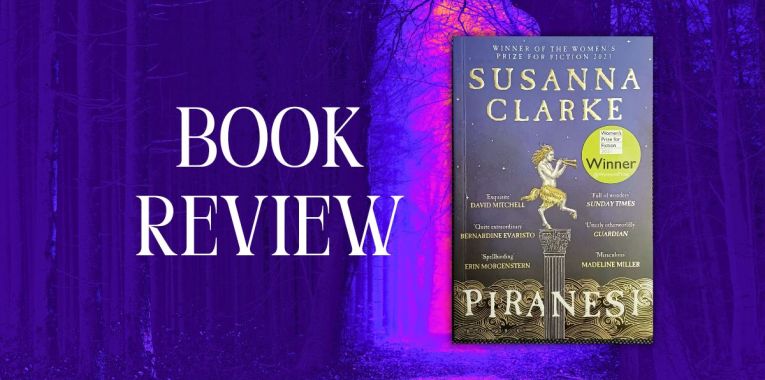
Book Review: ‘Piranesi’ by Susanna Clarke

Book four of 2024 is a book I read for my book club: ‘Piranesi’ by Susanna Clarke.

I’d heard a lot of hype surrounding this book, and its Goodreads score is awe-inspiring. People from a few different circles have suggested this novel to me. It’s won awards.

First of all, the good. I loved the character of Piranesi. He’s adorable and heartfelt, like a lost puppy. The other characters were also super interesting. The story was great, and learning about the house and its circumstances was fun. The very idea of the house is fascinating. The initial mental images of the place were vibrant and grounded.

So, I must have loved the book. Right?

Well, no. And why not? There are endless hallways and vestibules—on and on and on for 250 pages or so. At some point, I began to get irritated. Immersing yourself in these sorts of books is a delight for many readers. But it’s not for me. I need more direction and urgency.

It’s an excellent book that will appeal to many. But if you’re like me and get annoyed by unhurried prose and somnolent storytelling, it might not be for you.

And that’s okay.

Book Review: ‘The Mist’ by Stephen King

After my previous read, I reread Stephen King’s ‘The Mist’ as a palette cleanser for my next book of the year.

‘The Mist’ is a shorter book, perfect for my current mood. I needed something to remind me that I can enjoy reading when the writing style matches my reading style. Some things click with you; some things don’t.

And King very much clicks with me.

The story follows Dave and his son, “Big” Bill, in the wake of a storm for the ages. Trees have fallen, and wooden piers have sunk. Cars and garages have suffered damage. And an odd mist is creeping in over the lake. Dave heads a small group into town to pick up supplies for the next few days without power. They leave Dave’s wife and Bill’s mother alone at the house, which has suffered a smashed-in window. But whilst in the local supermarket, the mist closes in and traps them inside.

And there’s something awful in the mist.

I will keep the details of the story secret. You should read it (or watch the movie—it’s fantastic) and find out for yourself. But I recommend starting with the book and moving on to the film. I will say this for the film: it surpasses King’s ending on paper here. (Although that’s not to say that King stumbles on the landing.)

King’s style makes the short novella—a little under 200 pages—feel like a pamphlet. The pages fly by, making you wish he’d turned it into a full-length novel. He has the gift, after all. But, then again, King might have chosen this format for a reason.

‘The Mist’ is a short, sharp jab to the dome; it packs a punch.

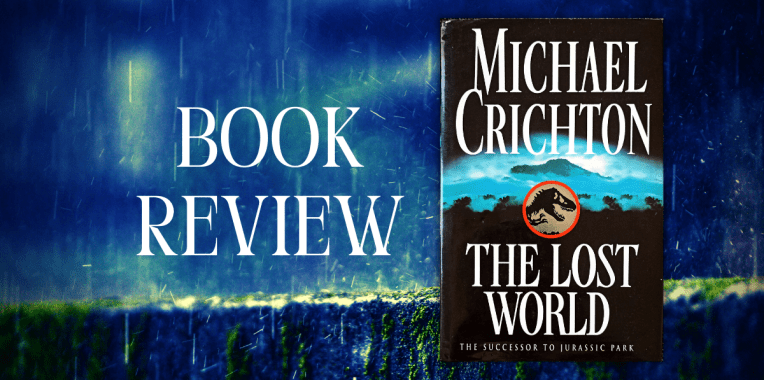
Book Review: “The Lost World” by Michael Crichton

Book 18 of 2023 is Michael Crichton’s “The Lost World”.

A four-year-old dinosaur-obsessed Joshua saw a movie in ’97. That movie, of course, was the summer blockbuster, “The Lost World: Jurassic Park.” It was everything kid Josh wanted in a movie. Years later, as an adult, although I recognise the first film as superior, I still have a soft spot for the sequel.

I read Crichton’s “Jurassic Park” a while back—sometime during one of the lockdowns—and liked it. I came to the odd conclusion that I preferred the movie. Spielberg refined and focused the book’s ideas and crystallised them. I can say the same about the sequel, for the most part.

But that’s not to say I didn’t enjoy the book. I loved it. Crichton’s power lies not in writing but in worldbuilding and storytelling.

A fair few parts differ from the movie. The entire premise has a different angle, as John Hammond dies in the first book. A friend of Ian Malcolm is trying to find out where these strange animal corpses are coming from. Surprise, surprise, these turn out to be dinosaurs. Some parts of the book are better—such as Sarah Harding’s character and the dinosaur variety. Some bits are worse—such as the T. rexes’ attack on the trailer and the velociraptors in the long grass. I also preferred Ian Malcolm in the movie.

But, all in all, I had a great time with “The Lost World”. Crichton might have penned it for the movie sequel, but that’s where the book shines. The best parts are the realistic—ish—ways the plot unfolds and the big, bombastic setpieces.

Much like the book’s tagline, I can say this about my love of dinosaurs:

Something has survived.

Book Review: “The Institute” by Stephen King

I chose a book that waited a while on my shelf for my next read of 2023, Stephen King’s “The Institute”.

I’m a King fanboy; everyone who knows me knows that. So let me cut right to the chase: this book is brilliant. It is absurd that the man is still pumping out books of this calibre at this stage in his career. King has written so many classics that he could get away with phoning it in at 75. But that’s not King’s style. Instead, he has added another masterpiece to his long list of masterpieces.

The book follows two characters. The first is a shamed policeman on the search for something new. The second—and most important—is a boy, kidnapped in the middle of the night and taken to a detention centre in Maine. Where else would King set it?

It’s, of course, less horror than some of King’s other works. But it recalls his other pieces, such as “Firestarter”. If you’re a fan of his kids-with-psychic-powers books, you’ll adore “The Institute”. Hell, even if you’re not, I’d still recommend it. It’s that good.

I’ve said it before, and I’ll repeat it, King is king.

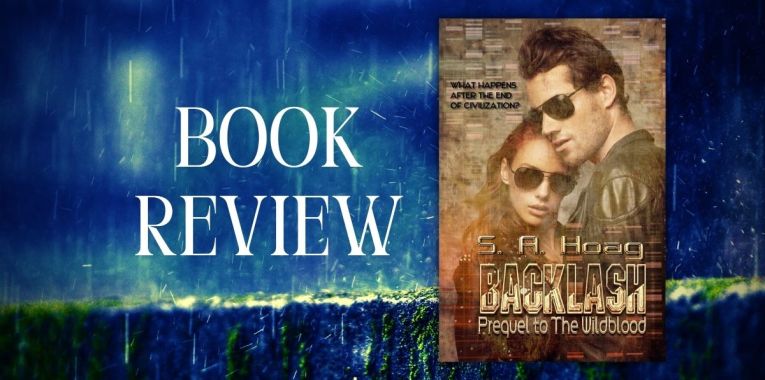
Book Review: “Backlash” by S. A. Hoag

S. A. Hoag’s Backlash is my eighth read of the year.

I wanted to review the works of other indie authors, and Hoag is the first. Backlash follows three characters after a great war has devastated the land. They volunteer to protect the last vestiges of humanity from the new world’s dangers. These three share eerie psychic abilities because they are genetically enhanced.

The setting is fascinating. As a horror and sci-fi nerd, apocalyptic tales always pique my interest. (After all, Fallout is one of my favourite video games.) Yet, Hoag wastes no time or energy on long-winded expositions and infodumps. Instead, she places the reader in the middle of the characters and trusts you are smart enough to figure it out.

The story moves at a breakneck pace, and Hoag keeps descriptions bare bones. This approach lets the story race past, uncluttered and streamlined. I’ve read short stories a tenth of Backlash‘s length that took me longer—I devoured it in two days.

Give Hoag’s work a shot; it won’t disappoint.

Book Review: “Flowers for Algernon” by Daniel Keyes

Daniel Keyes’s Flowers for Algernon marks my fourth read of the year.

And my god did this book ruin me. I underestimated how much Charlie and Algernon’s tale would touch my soul.

Charlie, a man with severe learning difficulties, volunteers for groundbreaking surgery. Surgery that the researchers have only—thus far—performed on mice. But as the most successful mouse test subject begins to fade, all eyes turn to Charlie.

Beautiful, heartbreaking, through-provoking, profound. What can I say about Keyes’s novel that others haven’t already? If you still need to read it, I assure you it’s worth your time.

Flowers for Algernon is a classic for a reason.