Book Review: ‘Reclaiming Art in the Age of Artifice’ by J. F. Martel

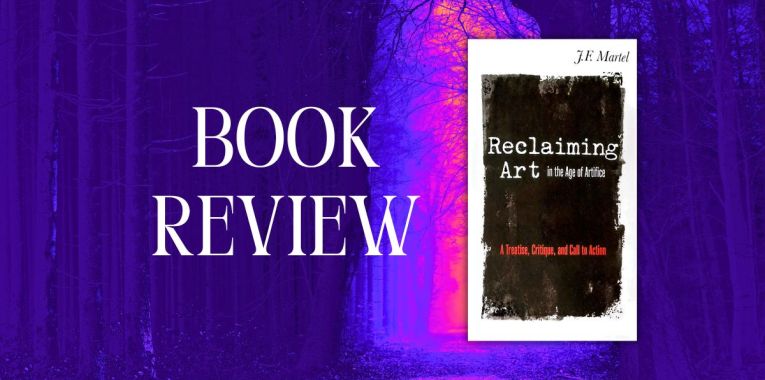
For my next read of 2024, I finally got around to reading J. F. Martel’s ‘Reclaiming Art in the Age of Artifice’.

Of course, you will gasp when you learn this book was a gift from my friend Leander. Since I like to create stories, music, and digital art, we’ve often discussed creativity and art. These conversation topics prompted Leander to gift ‘Reclaiming Art…’.

Martel is a writer and filmmaker in the Canadian TV and film industry; he has the credentials to discuss art. His writing style is not challenging or impenetrable – Martel writes to communicate. If it is sometimes difficult to read, it is because of the complexity of the topic.

As the subtitle claims, ‘Reclaiming Art…’ is a ‘Treatise, Critique, and Call to Action’. (He won me over with that use of an Oxford comma.) Martel differentiates – referencing James Joyce, Oscar Wilde, and James Cameron – art from artifice. Artifice, in simple terms, is either pornographic or didactic. I.e., it either makes the observer want something or want to avoid something. For example, an advert is artifice because it makes you want to buy something. True Art (TM) does no such thing. From there, ‘Reclaiming Art…’ goes off in ways I couldn’t summarise in a review.

While I have yet to grasp all of Martel’s ideas, what I did understand was inspiring. This book is for creators and consumers alike, especially if you’re weary of this modern world. It’s not only informative but also a call to action that can invigorate your creative spirit.

Reading ‘Reclaiming Art…’ has sparked a deep introspection into my creative process as a writer.

And that’s a powerful thing.
Book Review: ‘Stasiland’ by Anna Funder

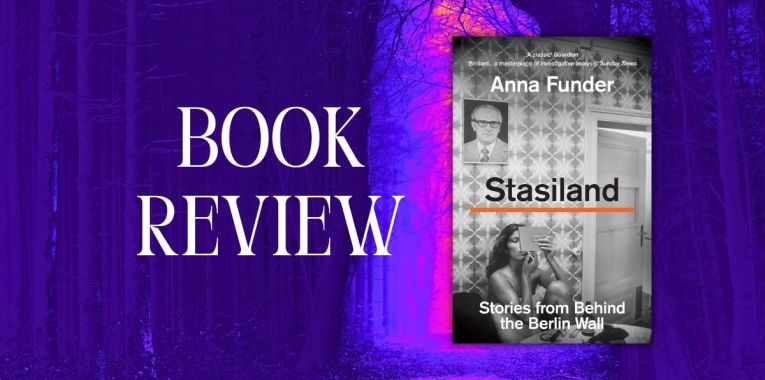
Anna Funder’s ‘Stasiland’ – a book club book – was my next read of the year.

As the title suggests, ‘Stasiland’ is a nonfiction book about East Germany during the GDR. What sets it apart is the perspective of its Australian author, Anna Funder. Funder visited Germany after the fall of the Berlin Wall. She found and interviewed people who lived during that era, including Stasis. ‘Stasiland’ weaves the interviewees’ and Funder’s stories together, as she navigates new Germany.

The book is informative and engaging. Considering its location in recent history, the material packs a punch and is weighty. Reading it, I learned a lot about this period. Hearing people’s opinions on both sides – for and against the division – was fascinating. The stories were breathtaking, the tension incredible, and many moments squeezed the heart. People can be so depraved and evil. People can be so brave and good. These people can live shoulder to shoulder.

While I can’t say that I ‘enjoyed’ this book in the traditional sense, it was riveting. The material is grim, but it’s not meant to be a fun read. It’s an educational journey through an unpleasant moment in time. It’s a book that will leave you with a deeper understanding of Germany’s history.

If Germany’s narrative over the last century interests you, I recommend ‘Stasiland’.

Book Review: “We Should All Be Feminists” by Chimamanda Ngozi Adichie

Chimamanda Ngozi Adichie’s “We Should All Be Feminists” is book 16 of 2023.

And—yeah, okay—it might be a bit of a cheat, considering its length. But my wife bought the book, and I couldn’t resist blowing through it in an hour.

Based on a TEDx talk that Adichie gave in 2012 of the same name, “We Should All Be Feminists” is what you’d expect. It’s a look at a contentious subject, one that people are wary of due to its volatile nature. But, and Adichie makes this point, it shouldn’t be so divisive. This is one of the many parts Adichie and I agree upon.

The book makes some excellent points about feminism. Adichie’s look at the roles of men and women is refreshing and on point. And the brevity of the book works to its advantage. I agreed with much of what Adichie said, except for a few moments.

The not-so-trans-positive statement “women can have babies, men cannot” got a raised eyebrow. Not surprising for a woman who defended J. K. Rowling. Also, “loss of virginity is a process that usually involves two people of opposite genders”? Not very LGBTQ+ friendly. So, whilst Adichie makes some excellent points, she also makes some blunders. For a book about feminism, I had hoped that it would have been more progressive.

Have a read—it won’t take long—but remember, it’s not the most inclusive piece of feminist literature.

‘(Don’t) Listen to Me’: An essay, of sorts, on privilege and injustice


This next piece was written for Reedsy, but it’s not so much a short story as it is a short essay. A rant, some may describe it as. I’ve been as honest as I can be in writing it. It was written for the contest A Time for Action. I honestly think this piece could have been submitted to any of the prompts, but the one I went with in the end was, “Write a story about solidarity.” You can read it here on WordPress or over on Reedsy.


Don’t listen to me.

Continue Reading