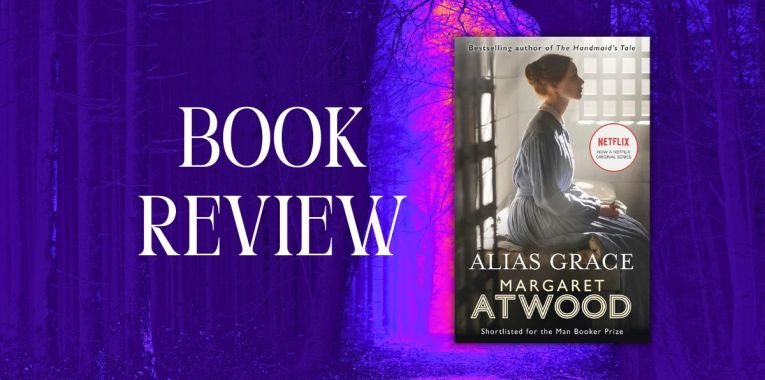
Book Review: ‘Alias Grace’ by Margaret Atwood

I started a new job this year, and with it came a company book club. How cool is that? This month’s pick is Margaret Atwood’s ‘Alias Grace’.

The novel follows Grace Marks, a young Irish girl born into poverty. We journey with her across the ocean to Canada, where she finds work as a servant in wealthier homes. And that’s where the trouble begins. Two people end up dead. The law hangs a man and sentences Grace to life in prison. But what happened? Is she guilty? That’s the novel’s beating heart and the question that kept me reading.

I loved ‘The Handmaid’s Tale’, but ‘Alias Grace’ didn’t hook me the same way – at least not at first. I struggled with the first third. For a 500+ page book, that’s a lot of slow going. It felt dry and meandering. But somewhere around page 200, things get interesting. Atwood finally gets her hooks in, and from then on, ‘Alias Grace’ keeps you guessing right up to the final pages. The palpable tension as we near the murder was excellent and breathless. The book also shows how women’s tales from the 1800s can mirror modern feminist struggles.

That said, the book is heavy with unnecessary detail. Atwood did her research and wants to show it, but we don’t need all the facts as readers. We need to trust that she knows her stuff. The book oscillates between building great tension and slowing itself down with excess.

In the end, I liked it. And that’s a testament to how strong the good bits are – they outweigh the negatives. With tighter editing and a slimmer page count (a la ‘Handmaid’s’), this could’ve been a four- or five-star read.

As it stands, ‘Alias Grace’ is a decent novel that urges reflection on modern inequalities.

⭐⭐⭐☆☆

Book Review: ‘Sleeping Beauties’ by Stephen and Owen King

Stephen and Owen King’s ‘Sleeping Beauties’ is—checks notes—book twenty-eight of 2023.

This massive book slab took me quite a while to get through; I started it on one of the last days of my honeymoon. That does not mean the novel is slow or tedious. I wanted to give it the space to breathe. I’ve had a great time immersing myself in this dystopian world.

Reminiscent of his heyday (‘The Stand’, ‘It’), ‘Sleeping Beauties’ is classic King. It’s his old-school, multi-character, small-town America story. The setup is unique—all women, all over the world, are falling asleep. Once unconscious, the women grow a cocoon. If a foolhardy person disturbs the webbing, the women explode in a rabid attack.

For an older, straight, white, rich American, King is far more liberal than you’d expect him to be. Sure, some points could be a smidge more progressive, but at no point does King fumble the ball. The ‘Sleeping Beauties’ themes are on-point and relevant when taken alone. The story becomes even more extraordinary when considering the man who wrote it.

Each character is well-drawn and believable and contains the depth for which we all know King. Even insignificant side characters are multidimensional, and their motives are understandable. The story builds and escalates until it all collapses in a thrilling finale. Nobody does that ‘fate spiralling down towards its inevitable conclusion’ thing like him.

Oh, and the idea of father and son working together on a novel? It’s so wholesome, despite the bleak apocalyptic tale.

King is king.

Or should that be, the Kings are king?

Book Review: “We Should All Be Feminists” by Chimamanda Ngozi Adichie

Chimamanda Ngozi Adichie’s “We Should All Be Feminists” is book 16 of 2023.

And—yeah, okay—it might be a bit of a cheat, considering its length. But my wife bought the book, and I couldn’t resist blowing through it in an hour.

Based on a TEDx talk that Adichie gave in 2012 of the same name, “We Should All Be Feminists” is what you’d expect. It’s a look at a contentious subject, one that people are wary of due to its volatile nature. But, and Adichie makes this point, it shouldn’t be so divisive. This is one of the many parts Adichie and I agree upon.

The book makes some excellent points about feminism. Adichie’s look at the roles of men and women is refreshing and on point. And the brevity of the book works to its advantage. I agreed with much of what Adichie said, except for a few moments.

The not-so-trans-positive statement “women can have babies, men cannot” got a raised eyebrow. Not surprising for a woman who defended J. K. Rowling. Also, “loss of virginity is a process that usually involves two people of opposite genders”? Not very LGBTQ+ friendly. So, whilst Adichie makes some excellent points, she also makes some blunders. For a book about feminism, I had hoped that it would have been more progressive.

Have a read—it won’t take long—but remember, it’s not the most inclusive piece of feminist literature.